Order not to harm Dinah
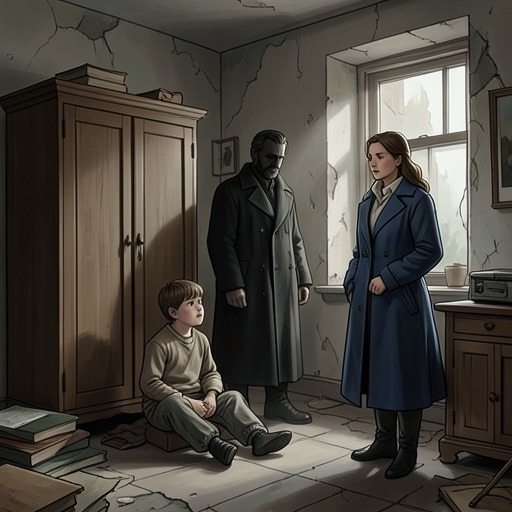
Down Cemetery RoadThe order not to harm Dinah Singleton is a repeated limit placed on the covert operation surrounding her after Axel Crane’s bombing of the Singleton house. Howard insists that she remain unharmed, and Amos Crane assures him that she is safe; yet her survival is also discussed as a strategic asset. The rule therefore offers a narrow protection to one child inside a system prepared to conceal violence and use her presence for its own purposes.
Origins and immediate pressure
After the explosion, Howard has to defend a fait accompli: he says he first learned of Axel Crane’s operation once it was already over. The public explanation is a gas leak, and he tells a senior official that the story will hold. But the official immediately asks whether the child is safe and whether Axel has harmed her. Howard answers that she is fine; the reply that she had better be fine makes clear that Dinah’s survival is not a minor detail to be settled after the cover story.
The official’s warning is expressed in terms of the damage a dead child would do to the operation’s secrecy. A baby killed in a covert bombing, he argues, could attract sustained media attention and documentaries. He identifies Axel as the brother responsible, condemns his recklessness, and asks what he might do next. The concern is thus double-edged: Dinah must not be harmed, but her safety is also bound up with preventing public exposure of the operation and its perpetrators.
That pressure continues in a later exchange. The senior official tells Howard that the government will take extreme measures to prevent Michael Downey from speaking publicly, while ruling out any open acknowledgment of that possibility. He then returns to the immediate question of what is being done with the child and urges Howard to act faster. The instruction is not presented as a broad reconsideration of the operation; it is a specific constraint amid efforts to control its consequences.
A limit within the plan
Howard’s private assessment complicates the appearance of a straightforward protective rule. He recognizes that Axel’s explosion did not allow for complete control and that repairing its consequences requires an awkward cover-up. Amos Crane, though protective of his younger brother, also admits he would not have chosen Axel’s method in a field situation. Yet Amos interprets Dinah’s survival as an opportunity: in his view, she remains on the board, and they should use her carefully.
Howard is less certain that this is wise. He worries that people may accept an adult’s disappearance by inventing an explanation, but an infant is different: observers are less likely to believe a child chose to leave or changed her life. The police, local press, and inquest may help close the matter, but the child’s continued existence could prompt someone to look for her. The order not to harm her therefore operates alongside a plan that depends on managing her whereabouts and on keeping others from asking questions.
The language of protection is made pointedly uneasy by the setting. When Howard asks where the child is, Amos says she is tucked up in bed. Howard repeats that she is not to be harmed; Amos assures him she is safe as houses. The reassurance follows a bombing, and the men pause to think about houses recently brought to their attention. That small exchange makes safety sound less like an established condition than a promise being tested against the damage already done.
Enforcement and limits
Howard restates the rule directly to Amos: the child must not be hurt. Amos responds with raised palms, a gesture of innocence, and repeats his assurance. Howard then threatens to hold Amos’s brother responsible if Dinah is harmed. The threat gives the instruction an identifiable enforcement mechanism: Howard cannot simply rely on Axel’s judgment, so he makes Amos answerable for his brother’s conduct.
The exchange also exposes the rule’s limits. Howard’s warning is aimed at preventing injury to Dinah, not at ending the operation or exposing what has happened. Amos writes down the threat, but the scene supplies no independent guarantee that the child is free or that the men’s assurances can be trusted. The order is consequently a real constraint within the plot, but not proof that the larger system has become protective.
Significance
The distinction between Dinah’s protected status and the operation’s broader violence is sharpened by the soldiers’ account of the desert. They say they were told to bring boy soldiers back alive, only to discover that the weapon being tested on them made the children melt. That account does not make the order concerning Dinah part of the same stated instruction; it does, however, place its limited safeguard beside an institutional record in which children have already been treated as targets in a secret experiment.
The rule’s force lies in this tension. It gives Howard a concrete boundary to insist upon, and his threat to Amos shows that he regards a failure to observe it as consequential. At the same time, the child’s safety is repeatedly discussed through the language of publicity, operational control, and strategic usefulness. Dinah is to be kept unharmed, but also kept within a plan whose secrecy matters more to its managers than accountability for the violence that brought her into their hands.